Earthquake Monitoring is one of the new directions being prepared for the Monitoring section of the Geohazards Exploitation Platform.
The goal is to provide a dedicated entry point for users who need to move quickly from a reported seismic event to Earth Observation products that help show where the ground moved, how much it moved, and how the displacement evolves after the event.
This work builds on Terradue’s experience with event-driven EO processing pipelines and is being developed as an internal GEP capability. The service is currently under deployment and will be shared progressively as the monitoring workflow and user interface become available.
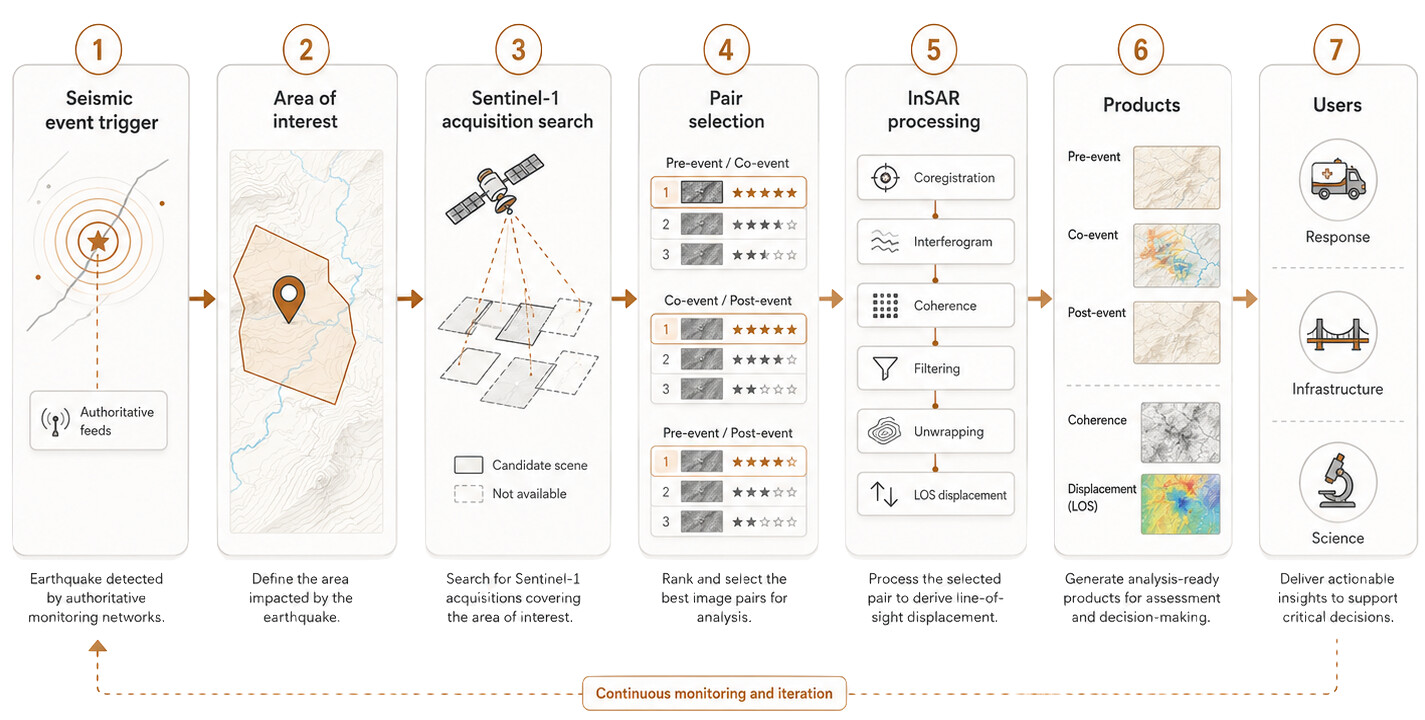
From earthquake trigger to displacement products
The Earthquake Monitoring workflow is designed to automate the production of pre-event, co-event, and post-event interferograms from satellite SAR acquisitions.
When a significant earthquake is detected, the system identifies suitable Sentinel-1 acquisitions covering the affected area and ranks candidate image pairs for interferometric processing. The aim is to produce clear, spatially detailed products that can help users understand the observed surface displacement without requiring them to manage the full InSAR processing chain manually.
The processing workflow can support products such as:
- pre-seismic interferograms to characterise the background signal before the event;
- co-seismic interferograms to map the main displacement field associated with the earthquake;
- post-seismic interferograms to follow evolving motion after the event;
- coherence and quality layers to help users assess where the signal is reliable;
- line-of-sight displacement products for quantitative interpretation.
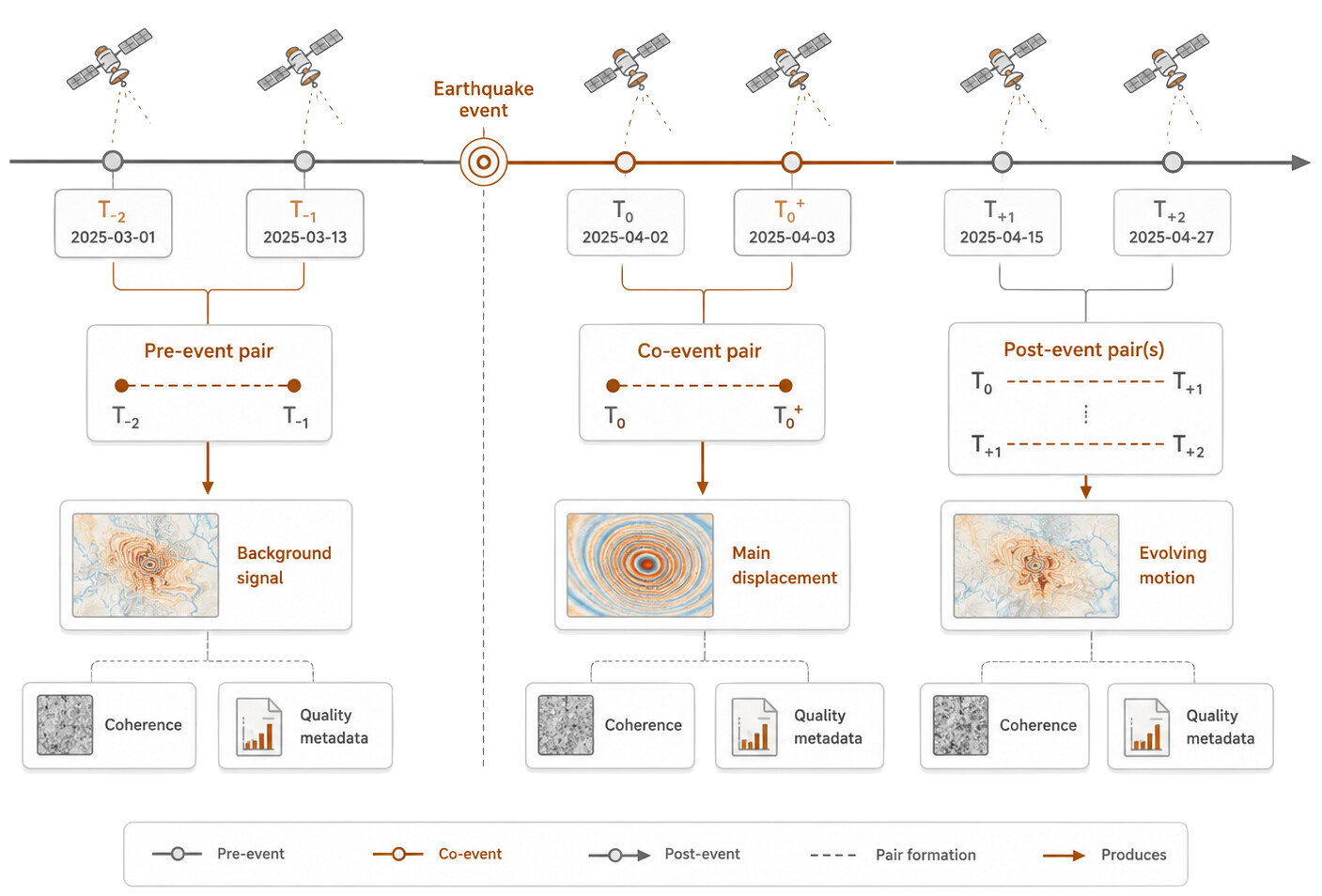
Why this matters
Automated earthquake interferogram production can help users turn raw SAR data into actionable information more quickly.
For response and recovery activities, displacement maps can help prioritise areas where roads, bridges, utilities, and other infrastructure may need closer inspection. For scientific users, the same products can support comparison with seismic and tectonic models. For engineering and insurance workflows, quantitative displacement information can provide an additional evidence layer for follow-up analysis.
The objective is not to replace specialist interpretation, but to make the first EO-derived evidence easier to discover, process, catalogue, and reuse.
How the future service is expected to work
The planned workflow follows a simple operational logic:
- A seismic event is detected from an authoritative earthquake feed.
- An area of interest is defined around the event, with the possibility to refine it using available impact or shaking information.
- Suitable Sentinel-1 acquisitions are selected according to coverage, timing, orbit geometry, and expected coherence.
- Candidate image pairs are processed to generate pre-event, co-event, and post-event interferogram products.
- Outputs are catalogued with provenance, quality, and coherence metadata.
- Products are exposed as interoperable geospatial layers that can be used in dashboards, GIS tools, and downstream workflows.
This approach is intended to support both fast situational awareness and longer-term product archives for validation, comparison, and research.
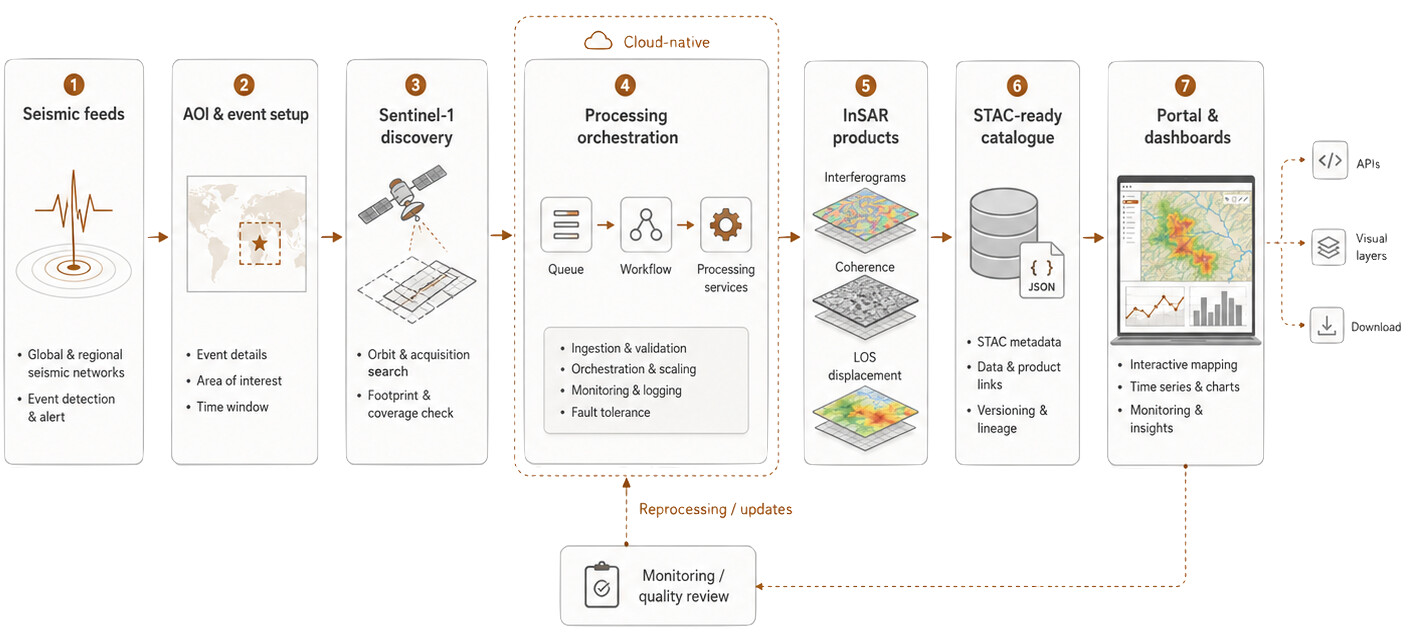
Image: Conceptual GEP Earthquake Monitoring entry point, linking event triggers, SAR processing, catalogued products, and user dashboards.
What users may be able to do
As the service evolves, the Earthquake Monitoring entry point is expected to help users:
- inspect recent significant earthquakes and related areas of interest;
- discover relevant Sentinel-1 acquisitions before and after an event;
- access generated interferogram, coherence, and displacement products;
- compare products across pre-event, co-event, and post-event time windows;
- review product quality and provenance metadata;
- export or integrate outputs into dashboards and downstream analysis environments.
The products are expected to be prepared in interoperable, searchable formats so they can be reused more easily by analysts, engineers, researchers, and application developers.
Coming next
The Earthquake Monitoring section will be used to share updates on this upcoming capability, including service status, example workflows, demonstration cases, and access information once the app is ready for wider testing.
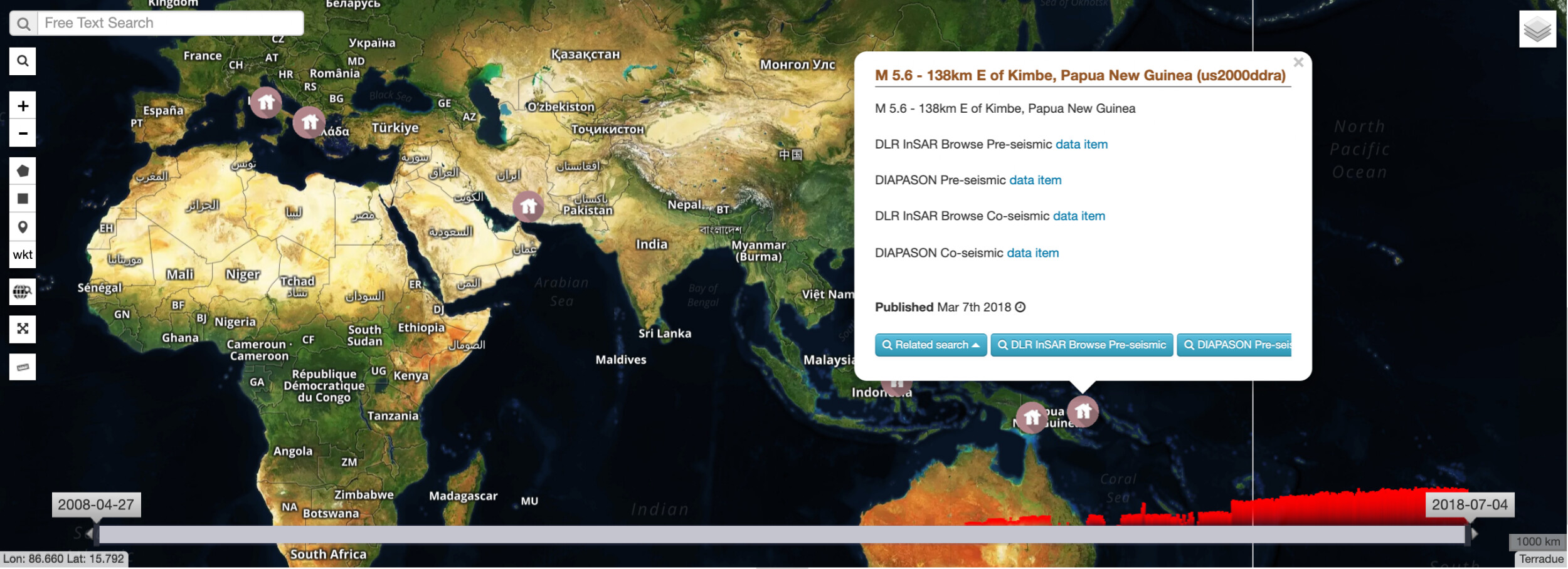
We will update this topic as the Earthquake Monitoring entry point progresses and more workflows become available. Click Watching at the bottom of the topic if you would like to receive notifications when new information is posted.