Earth Observation platforms are entering a new phase in which the challenge is not only to make satellite data easier to discover, process, analyse and share in the cloud, but also to help users combine data, services, workflows and expert knowledge in a more guided and reusable way. For geohazards, this is particularly relevant because users often need to move from an observation need to a trusted workflow, from a processing result to an interpretation, and from an individual analysis to reusable knowledge that can support monitoring, validation and decision-making.
For GEP, this direction is a natural evolution of the platform and of the collaborative environment that has been built around it. GEP already brings together many of the building blocks needed for this next step, including EO data discovery, processing services, Application Packages, notebooks, cloud-hosted workspaces, Drive, GitLab collaboration spaces, catalogues, service outputs and monitoring workflows for different geohazard domains. The roadmap is to make these capabilities easier to discover, describe, combine, execute and reuse, while keeping expert users and service providers in control of the workflow.
From platform capabilities to assisted orchestration
GEP is not only a data portal or a catalogue, but a working environment where users, service providers, project teams and platform operators collaborate around Earth Observation workflows. This collaborative nature is important because future agent-assisted systems will need to operate across real ecosystems of data, services, tools and communities, rather than inside isolated demonstrations where all components are prepared for a single use case.
In practice, GEP already supports many of the steps that users need when working with geohazard data: finding relevant EO products, running reusable processing services, analysing results in notebooks or GIS environments, managing outputs in shared storage, and organising technical assets in GitLab. Preparing GEP for agent-assisted workflows is therefore mainly about connecting these existing capabilities more systematically and making them easier for both users and software agents to understand.
From user objective to trusted workflow
A useful way to think about this evolution is to start from the user objective. A user may not begin by knowing the exact dataset, processing service, parameter set, storage location or notebook to use, but may simply want to monitor ground deformation after an earthquake, analyse a volcanic unrest episode, or prepare a wildfire impact assessment. In a more assisted workflow, GEP could help translate that objective into a practical execution path.
The platform could help identify relevant data, suggest suitable Application Packages or processing services, prepare the workflow, run the processing close to the data, organise the outputs, and support interpretation in notebooks or GIS tools. This does not mean replacing scientific expertise or hiding the process in a black box. The agent-assisted part is better understood as a planning and orchestration layer that helps select and connect the right platform capabilities, checks that the required data and services are available, follows the execution, and keeps the result traceable for expert validation.
*
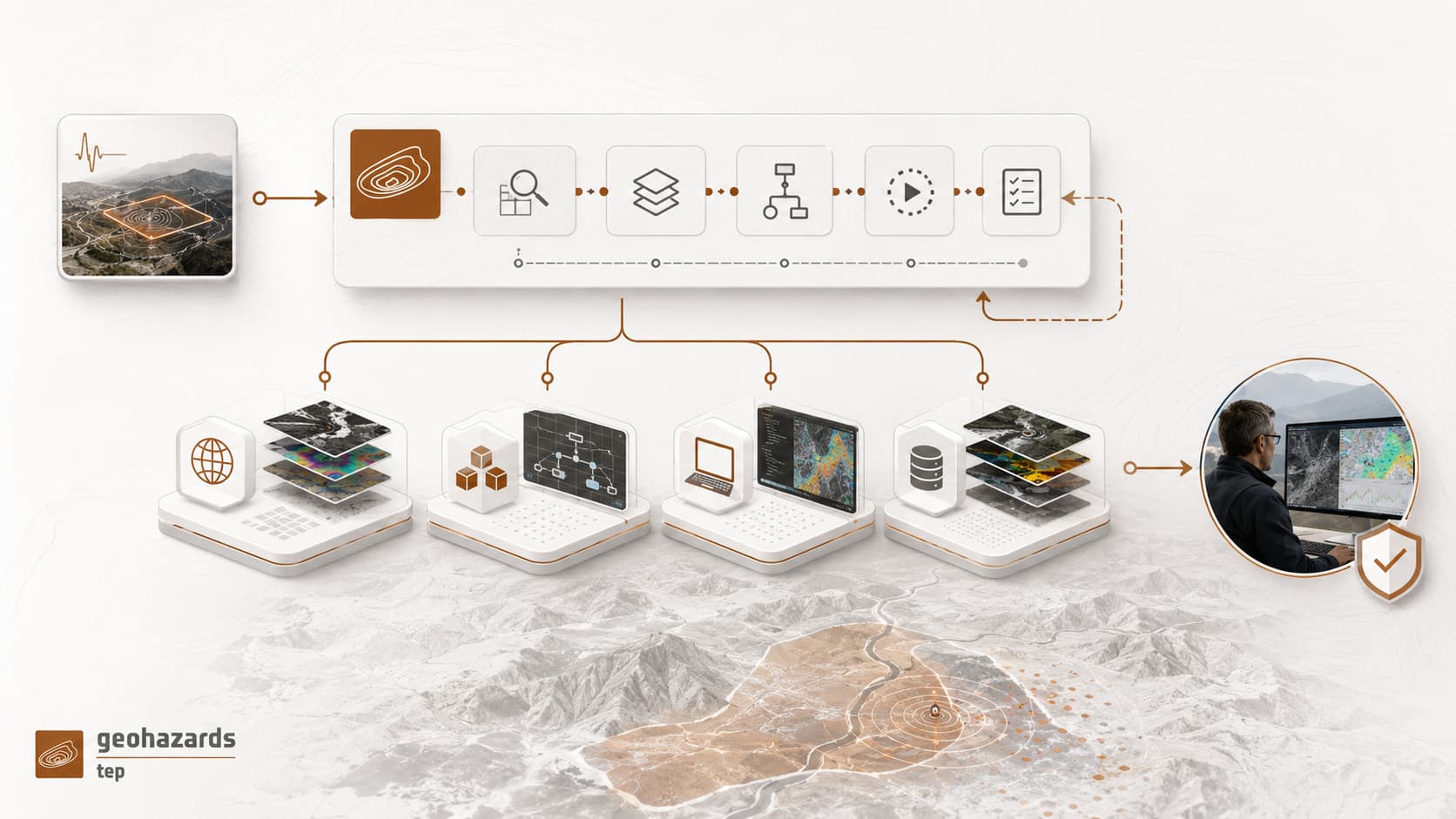
Agent-assisted orchestration on GEP: from a user objective to a traceable workflow plan that can discover data, select services, execute processing, organise outputs, and support expert validation.*
As illustrated above a geohazard objective is transformed into a task plan, the plan connects existing GEP capabilities, and the final result remains subject to expert validation and use. The important point is that the “agentic” element is not represented as a separate artificial intelligence object, but as the assisted planning, selection, execution and checking of a workflow built from existing platform capabilities.
A collaborative ecosystem for intelligent EO services
Agent-assisted workflows are not only a technical question, because they also depend on the ecosystem around the platform. GEP already works through the interaction of expert users, service providers, scientific teams, project partners, platform operators, institutional activities, sponsored access, commercial users and community initiatives. This is one of GEP’s strengths, as future Earth Observation workflows will increasingly need to combine capabilities that belong to different actors.
Application Packages provide reusable processing capabilities, notebooks capture analysis methods and expert knowledge, scientific suites make persistent tools available to users, catalogues and storage connect data with outputs, and subscriptions or collaborations provide controlled spaces for users and projects. Together, these elements create a practical environment where new orchestration patterns can be tested progressively with real data, real services and real geohazard use cases.
A practical roadmap
A realistic roadmap for GEP can be built step by step, starting with the capabilities that already exist and making them easier to describe and combine. The first step is to make datasets, Application Packages, notebooks, tools, suites, inputs, outputs and parameters easier to discover and interpret. This is important because assisted workflows can only reason over capabilities that are clearly documented, versioned and accessible.
The next step is to connect catalogues, storage, services and workspaces more systematically, so that a workflow can understand where data comes from, where outputs are written, which catalogue records describe them, and how they can be opened in notebooks, QGIS or other analysis environments. From there, GEP can progressively support assisted workflow planning, where users describe a goal and the platform helps propose a path involving data discovery, service selection, processing, analysis and validation.
Over time, some orchestration steps can become more automated, while remaining permission-aware, traceable and auditable. These ideas can be tested first in areas where GEP already has strong foundations, including monitoring workflows for earthquakes, volcanoes, wildfires, floods, landslides, subsidence and critical infrastructure.
Preparing the next step
The future of EO platforms will not depend only on providing access to more data or more processing capacity, but also on how effectively platforms help users discover, combine, trust and reuse capabilities. For GEP, agent-assisted workflows are a natural extension of what the platform already does, because the building blocks are already present and the next step is to connect them in more intelligent, transparent and reusable ways.
This roadmap will be prepared progressively, building on GEP’s existing services, collaborative structure, operational experience and the organisations involved in its evolution. The objective is not to turn GEP into a black-box AI system, but to prepare the platform for a new generation of Earth Observation workflows where human expertise, reusable services and assisted orchestration can work together.
This article presents a forward-looking perspective on how GEP can evolve towards more intelligent and agent-assisted workflow orchestration. These capabilities will be prepared progressively, building on existing GEP concepts such as catalogues, EO Application Packages, processing services, notebooks, Drive, GitLab collaboration spaces, subscriptions, storage and operational monitoring workflows.